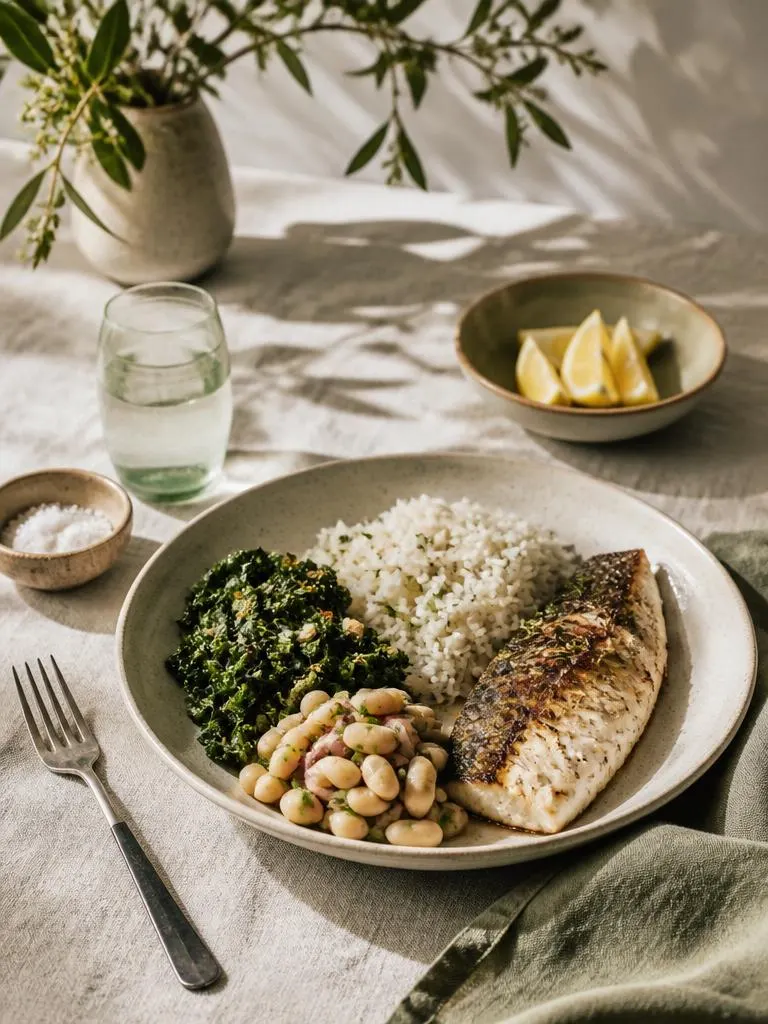
Restriction works until it doesn’t. What holds is a way of eating and moving you can repeat when life is busy — enough protein and fibre, enough sleep, regular movement, and an honest relationship with food that doesn’t run on shame.
Educational guidance only — never a replacement for your doctor.
Slower is not weaker. The plan you can keep is the plan that works.
0.5–1%
Body weight per week — the rate that best preserves muscle
1.2–1.6g
Protein per kg most often used in appetite and muscle studies
2×/wk
Strength sessions that protect lean mass while losing fat
0
Detoxes, meal replacements or before-and-after theatre
What actually helps
Change the environment, not just the willpower.
Appetite is biology, not character. Sleep debt, ultra-processed convenience, liquid calories and long gaps between meals all push intake up quietly. Fix those and eating less stops feeling like a fight.
Protein at every meal
It is the most satiating macronutrient, and it protects muscle while you lose fat.
Walk more than you train
Daily steps move total energy expenditure more than a couple of hard sessions do.
Sleep changes appetite
Short sleep reliably raises hunger and lowers restraint the next day — measured in trials, not folklore.
How it works
Three steps, at your own pace.
Step 01
Set an honest baseline
Two weeks of no changes, just observation: meals, steps, sleep, alcohol. We plan from reality, not memory.
Step 02
Add structure, not rules
Protein and fibre anchors at each meal, a step target you can actually hit, and two short strength sessions.
Step 03
Ride the plateaus
Plateaus are normal physiology. We adjust calmly instead of crash-cutting and rebounding.
Evidence, plainly
What the research does — and doesn’t — support.
“Carbs make you gain weight.”
Total intake and consistency drive change. Low-carb works for some people because it happens to reduce intake, not because carbs are uniquely fattening.
“You must be in the gym daily.”
Two strength sessions and a walkable daily routine outperform sporadic intensity that you abandon in March.
“The scale is the score.”
Water, salt, cycle phase and glycogen swing it by kilos. Waist, strength, sleep and clothes tell a steadier story.
We will work with your metabolism, not against it.
Repeated restriction teaches your body to defend its weight — appetite rises, movement quietly falls, and the loss comes back with interest. The way out is not another deficit: it is enough protein and fibre to stay full, strength work that protects lean mass, sleep that steadies your hunger hormones, and a rate of change slow enough to hold. That is the whole method, and it is the one that lasts.
There’s a reason people are raving about this method.
Join the people who stopped restricting, started building, and achieved lasting weight loss.
15,000+
Readers following this approach worldwide
0.5–1%
Body weight a week — the rate that actually holds
12wk
Typical window before the change feels permanent
0
Detoxes, meal replacements or crash plans
Ruth A.43, Lagos★★★★★
Down 14kg, no dieting
“I stopped cutting and started eating enough protein, which felt completely backwards at the time. The loss was slower than anything I'd done before and I nearly abandoned it twice. Eighteen months later it's still gone, and that's never happened with a diet.”
Michael O.38, Chicago★★★★★
The plateau advice saved me
“Six weeks of nothing on the scale and my instinct was to slash my food and rebound again by Christmas. Thrive explained why plateaus happen and told me to hold steady and be patient. Three weeks later it moved, and I hadn't undone anything.”
Sarah K.36, Manchester★★★★★
Protein first was the whole trick
“I'd always started with cutting things out and been ravenous by four in the afternoon. Building each meal around protein first meant I simply stopped raiding the kitchen. For the first time in years I wasn't fighting my own appetite all day.”
Ibrahim S.45, Abuja★★★★★
My waist changed before the scale did
“Week five and the number hadn't moved, which historically is where I quit. Thrive had told me to measure my waist too, and that had come down four centimetres. That single reframe is the only reason I kept going.”
Nina P.41, Toronto★★★★★
Steps, not the gym
“I'd been told to do an hour of cardio five times a week and lasted about a fortnight. Eight thousand steps a day plus two short strength sessions fits around a real job. It's less impressive and infinitely more sustainable.”
Grace T.50, Bristol★★★★★
No shame in the plan
“Every programme I'd paid for treated my willpower as the fault to be corrected. This one explained the physiology of why restriction backfires and never once made me the problem. I stopped dreading the reading, which is half the battle.”
Kunle B.37, Ibadan★★★★★
Kept the muscle this time
“The last two times I lost weight I ended up smaller and noticeably weaker. Adding proper strength work twice a week made a visible difference to how the loss looked. Same number on the scale as 2022, completely different body.”
Helen R.47, Dublin★★★★★
I stopped weighing daily
“The daily number was dictating my mood before I'd even had breakfast. Switching to a weekly average took all the drama out of normal fluctuation. Same trend line, a fraction of the panic.”
Ade F.52, London★★★★★
9kg down, blood sugar normal
“I wasn't even doing it for the bloods — that was a side effect of the food and the walking. My doctor was the one who noticed and asked what I'd changed. Nine kilos, and a set of results I'm not nervous about anymore.”
Carla M.34, Houston★★★★★
Fibre fixed my hunger
“I was eating enough calories and still constantly hungry, which made no sense to me. Thrive pointed at fibre and volume rather than more willpower. The four o'clock snacking that had defeated every plan simply stopped.”
Dan W.44, Leeds★★★★★
Alcohol was the hidden third meal
“I'd been meticulous about food and completely blind to four or five drinks a week. Seeing what that was contributing, and what it was doing to my sleep, made it obvious. I didn't quit — I just stopped pretending it didn't count.”
Blessing E.31, Port Harcourt★★★★★
Realistic for shift work
“Everything else I'd read assumed three meals at civilised hours and a full night's sleep. This gave me structures that survive nights and days in the same week. First plan I've been able to keep through a full rota.”
Yvonne A.48, Vancouver★★★★★
Down two dress sizes
“Six months, no meal replacements, no detox teas, nothing I had to reorder each month. Just protein, fibre, walking and enough sleep that I wasn't eating out of exhaustion. Two dress sizes down and my food shop looks entirely normal.”
Tom H.39, Sydney★★★★★
The measurements beyond the scale
“Thrive asked me to track sleep, energy and what I could lift alongside my weight. All three improved weeks before the scale did anything interesting. Having those to look at is what stopped me giving up early.”
Priya N.42, Birmingham★★★★★
No supplements pushed on me
“After years of being advertised at, I expected a fat-burner recommendation by the end of the first page. It never came — just food, movement and sleep, with a note on when testing is worth it. Refreshing, and it made me trust everything else.”
Ruth A.43, Lagos★★★★★
Down 14kg, no dieting
“I stopped cutting and started eating enough protein, which felt completely backwards at the time. The loss was slower than anything I'd done before and I nearly abandoned it twice. Eighteen months later it's still gone, and that's never happened with a diet.”
Michael O.38, Chicago★★★★★
The plateau advice saved me
“Six weeks of nothing on the scale and my instinct was to slash my food and rebound again by Christmas. Thrive explained why plateaus happen and told me to hold steady and be patient. Three weeks later it moved, and I hadn't undone anything.”
Sarah K.36, Manchester★★★★★
Protein first was the whole trick
“I'd always started with cutting things out and been ravenous by four in the afternoon. Building each meal around protein first meant I simply stopped raiding the kitchen. For the first time in years I wasn't fighting my own appetite all day.”
Ibrahim S.45, Abuja★★★★★
My waist changed before the scale did
“Week five and the number hadn't moved, which historically is where I quit. Thrive had told me to measure my waist too, and that had come down four centimetres. That single reframe is the only reason I kept going.”
Nina P.41, Toronto★★★★★
Steps, not the gym
“I'd been told to do an hour of cardio five times a week and lasted about a fortnight. Eight thousand steps a day plus two short strength sessions fits around a real job. It's less impressive and infinitely more sustainable.”
Grace T.50, Bristol★★★★★
No shame in the plan
“Every programme I'd paid for treated my willpower as the fault to be corrected. This one explained the physiology of why restriction backfires and never once made me the problem. I stopped dreading the reading, which is half the battle.”
Kunle B.37, Ibadan★★★★★
Kept the muscle this time
“The last two times I lost weight I ended up smaller and noticeably weaker. Adding proper strength work twice a week made a visible difference to how the loss looked. Same number on the scale as 2022, completely different body.”
Helen R.47, Dublin★★★★★
I stopped weighing daily
“The daily number was dictating my mood before I'd even had breakfast. Switching to a weekly average took all the drama out of normal fluctuation. Same trend line, a fraction of the panic.”
Ade F.52, London★★★★★
9kg down, blood sugar normal
“I wasn't even doing it for the bloods — that was a side effect of the food and the walking. My doctor was the one who noticed and asked what I'd changed. Nine kilos, and a set of results I'm not nervous about anymore.”
Carla M.34, Houston★★★★★
Fibre fixed my hunger
“I was eating enough calories and still constantly hungry, which made no sense to me. Thrive pointed at fibre and volume rather than more willpower. The four o'clock snacking that had defeated every plan simply stopped.”
Dan W.44, Leeds★★★★★
Alcohol was the hidden third meal
“I'd been meticulous about food and completely blind to four or five drinks a week. Seeing what that was contributing, and what it was doing to my sleep, made it obvious. I didn't quit — I just stopped pretending it didn't count.”
Blessing E.31, Port Harcourt★★★★★
Realistic for shift work
“Everything else I'd read assumed three meals at civilised hours and a full night's sleep. This gave me structures that survive nights and days in the same week. First plan I've been able to keep through a full rota.”
Yvonne A.48, Vancouver★★★★★
Down two dress sizes
“Six months, no meal replacements, no detox teas, nothing I had to reorder each month. Just protein, fibre, walking and enough sleep that I wasn't eating out of exhaustion. Two dress sizes down and my food shop looks entirely normal.”
Tom H.39, Sydney★★★★★
The measurements beyond the scale
“Thrive asked me to track sleep, energy and what I could lift alongside my weight. All three improved weeks before the scale did anything interesting. Having those to look at is what stopped me giving up early.”
Priya N.42, Birmingham★★★★★
No supplements pushed on me
“After years of being advertised at, I expected a fat-burner recommendation by the end of the first page. It never came — just food, movement and sleep, with a note on when testing is worth it. Refreshing, and it made me trust everything else.”
Chidera U.35, Enugu★★★★★
Sustainable really meant sustainable
“I've used that word about plans I abandoned inside two months. This one survived a holiday, a house move and a very bad December. A year on and I've not had to 'start again' once.”
Angela D.54, Cardiff★★★★★
Menopause weight finally shifted
“The advice I kept getting was to eat less and less, and it kept doing nothing. Strength training and more protein was the opposite of that, and it worked. I wish somebody had told me five years ago.”
Segun A.46, Lagos★★★★★
Family meals didn't change much
“I wasn't cooking two dinners or eating something sad while everyone else ate properly. It was mostly proportions and one swap at breakfast. That's exactly why it's still going nine months later.”
Lisa G.33, Boston★★★★★
Lost the 3pm crash too
“I'd been treating the afternoon slump as a caffeine problem for about a decade. It turned out to be a breakfast problem, and the fix took one week to feel. My afternoons are genuinely different now.”
Ken M.57, Ottawa★★★★★
Realistic rate expectations
“Half a kilo a week sounded far too slow to be worth doing at fifty-seven. Thrive was clear that faster usually costs muscle and rarely lasts, and I decided to trust that. Eight months later the slow version has beaten every fast one I've tried.”
Rita O.40, Abuja★★★★★
No before-and-after theatre
“No dramatic photos, no transformation stories, nobody selling me their own results. Just what changes weight, at what rate, and how to keep it. It's oddly calming to read health content that isn't performing.”
Frank L.61, Glasgow★★★★★
My knees stopped hurting
“I'd been told it was arthritis and that this was simply the shape of the rest of my life. Twelve kilos and a bit of leg strength work later, the stairs are fine. I'm not claiming a cure, but I'm walking again.”
Amaka I.37, Lagos★★★★★
Ate more, weighed less
“I'd been under-eating all day and then making it all back after eight in the evening. Eating properly at breakfast and lunch felt indulgent and reckless. The scale went down anyway, which took me a while to believe.”
Josh B.29, Denver★★★★★
Finally understand calories
“I'd counted them obsessively for years without ever really understanding the system. Thrive explained what they are and what they aren't in about four paragraphs. Now I can eat sensibly without tracking a thing.”
Halima Y.32, Kano★★★★★
Postnatal, at my own pace
“The internet was full of people back in their jeans by twelve weeks and I was nowhere near. Nothing in this made me feel late, and the advice assumed broken sleep and no free time. I got there, just quietly and about a year later.”
Marie C.45, Montreal★★★★★
The habits outlasted the plan
“I stopped 'following' anything around month four and the changes stayed anyway. That was apparently the entire point of doing it slowly. It's the first time weight loss has ended without an ending.”
Emeka N.43, Enugu★★★★★
11kg and still going
“Nothing about this is dramatic enough to make an interesting post about. Protein, steps, sleep, and not panicking during the flat weeks. Eleven kilos down over ten months and still moving in the right direction.”
Stella V.49, Nairobi★★★★★
I trust the sourcing
“Every claim I've followed up has led somewhere real, and the caveats are stated in the text. When something is uncertain, it says so rather than rounding up to a promise. In this corner of the internet that's genuinely unusual.”
Rob J.38, Auckland★★★★★
Weekends stopped undoing my week
“Five good days followed by two enormous ones had me running in place for years. One change to how Saturday started, and the pattern settled. That alone was worth more than any weekday discipline I'd tried.”
Toyin A.44, Lagos★★★★★
Best money I never spent
“I paid a coach four figures for a plan that was less useful than a free newsletter. This explains the reasoning instead of just handing over macros. I've sent it to three people who were about to make the same mistake I did.”
Chidera U.35, Enugu★★★★★
Sustainable really meant sustainable
“I've used that word about plans I abandoned inside two months. This one survived a holiday, a house move and a very bad December. A year on and I've not had to 'start again' once.”
Angela D.54, Cardiff★★★★★
Menopause weight finally shifted
“The advice I kept getting was to eat less and less, and it kept doing nothing. Strength training and more protein was the opposite of that, and it worked. I wish somebody had told me five years ago.”
Segun A.46, Lagos★★★★★
Family meals didn't change much
“I wasn't cooking two dinners or eating something sad while everyone else ate properly. It was mostly proportions and one swap at breakfast. That's exactly why it's still going nine months later.”
Lisa G.33, Boston★★★★★
Lost the 3pm crash too
“I'd been treating the afternoon slump as a caffeine problem for about a decade. It turned out to be a breakfast problem, and the fix took one week to feel. My afternoons are genuinely different now.”
Ken M.57, Ottawa★★★★★
Realistic rate expectations
“Half a kilo a week sounded far too slow to be worth doing at fifty-seven. Thrive was clear that faster usually costs muscle and rarely lasts, and I decided to trust that. Eight months later the slow version has beaten every fast one I've tried.”
Rita O.40, Abuja★★★★★
No before-and-after theatre
“No dramatic photos, no transformation stories, nobody selling me their own results. Just what changes weight, at what rate, and how to keep it. It's oddly calming to read health content that isn't performing.”
Frank L.61, Glasgow★★★★★
My knees stopped hurting
“I'd been told it was arthritis and that this was simply the shape of the rest of my life. Twelve kilos and a bit of leg strength work later, the stairs are fine. I'm not claiming a cure, but I'm walking again.”
Amaka I.37, Lagos★★★★★
Ate more, weighed less
“I'd been under-eating all day and then making it all back after eight in the evening. Eating properly at breakfast and lunch felt indulgent and reckless. The scale went down anyway, which took me a while to believe.”
Josh B.29, Denver★★★★★
Finally understand calories
“I'd counted them obsessively for years without ever really understanding the system. Thrive explained what they are and what they aren't in about four paragraphs. Now I can eat sensibly without tracking a thing.”
Halima Y.32, Kano★★★★★
Postnatal, at my own pace
“The internet was full of people back in their jeans by twelve weeks and I was nowhere near. Nothing in this made me feel late, and the advice assumed broken sleep and no free time. I got there, just quietly and about a year later.”
Marie C.45, Montreal★★★★★
The habits outlasted the plan
“I stopped 'following' anything around month four and the changes stayed anyway. That was apparently the entire point of doing it slowly. It's the first time weight loss has ended without an ending.”
Emeka N.43, Enugu★★★★★
11kg and still going
“Nothing about this is dramatic enough to make an interesting post about. Protein, steps, sleep, and not panicking during the flat weeks. Eleven kilos down over ten months and still moving in the right direction.”
Stella V.49, Nairobi★★★★★
I trust the sourcing
“Every claim I've followed up has led somewhere real, and the caveats are stated in the text. When something is uncertain, it says so rather than rounding up to a promise. In this corner of the internet that's genuinely unusual.”
Rob J.38, Auckland★★★★★
Weekends stopped undoing my week
“Five good days followed by two enormous ones had me running in place for years. One change to how Saturday started, and the pattern settled. That alone was worth more than any weekday discipline I'd tried.”
Toyin A.44, Lagos★★★★★
Best money I never spent
“I paid a coach four figures for a plan that was less useful than a free newsletter. This explains the reasoning instead of just handing over macros. I've sent it to three people who were about to make the same mistake I did.”
Reader reflections shared with the Thrive Wellness Network, used with permission. Individual experience varies; nothing here replaces medical advice.
The questions that come up most when someone has already lost and regained the same weight several times.
I’ve regained it every time. Why would this be different?
Because the target changes. Instead of the fastest possible loss, we build the eating and strength pattern you can hold at your new weight — and lose slowly enough that your appetite and energy stay with you.
Do I have to give up the food I love?
No. Nothing is banned. We add protein and fibre anchors first; most people find the restriction they were fighting quietly stops being necessary.
How fast should weight change?
About half to one percent of body weight a week. Faster usually costs muscle and rarely lasts.
Do I need to count calories?
Not necessarily. Many people do better with structure — protein and fibre anchors, consistent meal timing — than with tracking.
What about GLP-1 medication?
It’s a genuine clinical option for some people, prescribed and monitored by a doctor. It does not replace the habits that keep the result.
Build the version you can keep.
Join The Weekly Root and get one evidence-informed letter a week — plus first access when a program or guide opens. No pressure, unsubscribe any time.